

Canada’s Bill S-211, the Fighting Against Forced Labour and Child Labour in Supply Chains Act, marks a major shift in how the country addresses human rights risks in global supply chains. While it is often discussed in business and ESG circles, its implications reach deep into the justice system, border enforcement, and government agencies.
This article walks through the key stages of Bill S-211 and the practical impacts it is likely to have on courts, prosecutors, regulators, customs officials, and public institutions.
Listen to the Article
| Implementation Stage | Key Actions Required | Affected Entities | Responsible Government Agencies | Enforcement Powers and Penalties | Impact on the Justice System | Compliance Deadlines |
|---|---|---|---|---|---|---|
| Stage 1 – Introduction and Passage | Debate in Senate and House of Commons; Committee study and amendments; Final approval. | Parliament of Canada | Senate; House of Commons | Not in source | Legislative creation of new offences and regulatory framework. | Royal Assent received May 11, 2023 |
| Stage 2 – Coming Into Force | Act officially becomes law; entities become subject to reporting duties and penalty risks. | In-scope entities (Stock exchange listed or significant Canadian presence based on assets/revenue/employees). | Government of Canada | Risk of penalties for non-compliance begins. | Establishment of a new legal category for regulatory offences. | January 1, 2024 |
| Stage 3 – First Reporting Deadline | File annual modern slavery report with Minister; publish on website; obtain board approval and signatures. | In-scope private entities and federal government institutions. | Minister of Public Safety; Public Safety Canada | Summary offences for failing to file or publish reports; fines up to CAD $250,000. | Potential for summary offence prosecutions; demands for legal team reviews. | May 31, 2024 |
| Stage 4 – Ongoing Compliance, Enforcement, and Review | Annual reporting cycle; monitoring; inspections; investigations; due diligence documentation. | Reporting entities; Importers; Federal institutions (e.g., Infrastructure Canada). | Public Safety Canada; CBSA; Department of Justice; Public Services and Procurement Canada (PSPC) | Entry of premises; examination of documents; corrective orders; personal liability for directors/officers; seizure of non-compliant goods. | New regulatory cases; civil litigation (investor/NGO suits); challenges to enforcement; expert testimony on ESG. | Annual (Ongoing) |
1. What Bill S-211 Does in Plain Language
Bill S-211 is designed to increase transparency and accountability around forced labour and child labour in the supply chains of organizations that:
- Are listed on a Canadian stock exchange, or
- Have a significant presence in Canada based on assets, revenue, or number of employees.
These entities must publish an annual report on the steps they are taking to:
- Identify and assess the risk of forced and child labour in their operations and supply chains
- Prevent, reduce, or remediate those risks
- Assess the effectiveness of their actions over time
Failure to report, or reporting falsely, is not just a compliance issue—it is now a legal offence.
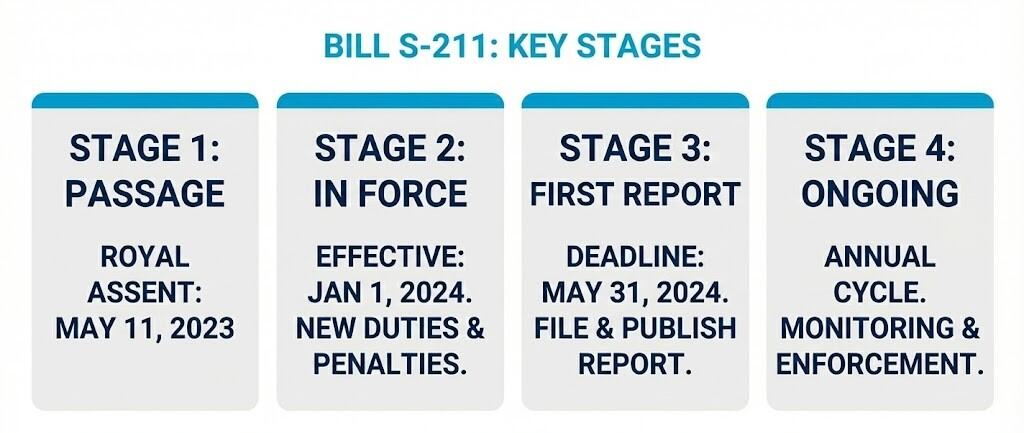
2. Key Stages of Bill S-211
Stage 1 – Introduction and Passage
Bill S-211 was introduced in the Senate and followed the usual legislative path:
- Debate in the Senate and House of Commons
- Committee study and potential amendments
- Final approval by both chambers
It received Royal Assent on May 11, 2023, officially becoming law.
Stage 2 – Coming Into Force
The Act came into force on January 1, 2024.
From this date onward, organizations that fall within the scope of the Act became subject to:
- New reporting duties
- The risk of penalties for non-compliance
Stage 3 – First Reporting Deadline
The first reporting deadline was May 31, 2024.
By that date, in-scope entities were required to:
- File their first annual modern slavery report with the Minister of Public Safety
- Publish that report prominently on their website
- Ensure the report was approved by their governing body (e.g., board of directors) and signed by a director, officer, or equivalent
Stage 4 – Ongoing Compliance, Enforcement, and Review
Going forward, the law operates on an annual reporting cycle, with:
- Ongoing monitoring by federal authorities
- Potential inspections or investigations
- A gradual evolution toward more robust enforcement as systems and expectations mature
This implementation phase is where the justice system and related agencies begin to feel the real impact.
3. New Powers and Responsibilities: Enforcement & Investigations
Bill S-211 gives the Minister of Public Safety and Emergency Preparedness and designated officials significant new tools to ensure compliance.
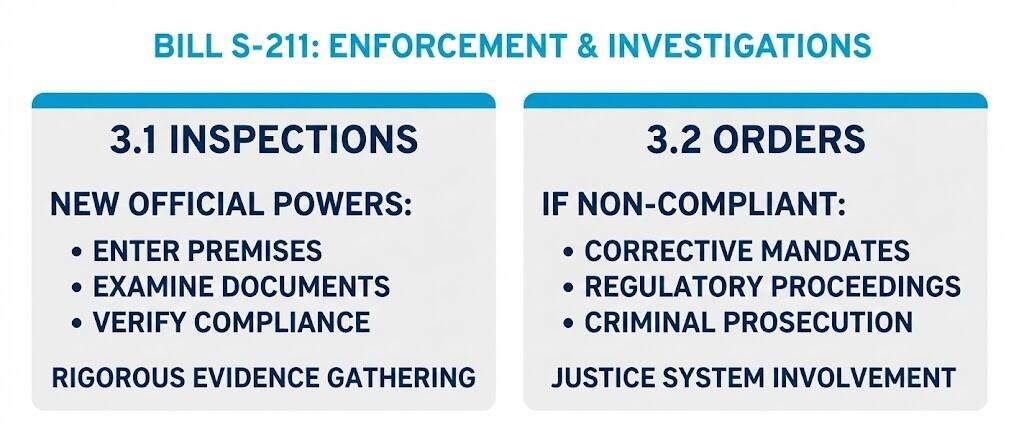
3.1 Inspections and Inquiries
Designated officials now have powers to:
- Enter business premises (subject to legal limitations)
- Examine and copy documents
- Request information necessary to verify compliance
These powers are similar in style to other regulatory regimes (e.g., environmental, competition, or securities law), and they introduce:
- More complex fact-finding and evidence-gathering responsibilities
- Increased demands on legal teams within both the government and private sector
3.2 Corrective Orders
If an entity is not complying, the Minister may issue orders requiring corrective actions.
Failure to comply with such orders can itself become an offence, potentially triggering:
- Regulatory proceedings
- Prosecution before the courts
This is where the justice system becomes directly involved.
4. Penalties, Prosecutions, and Corporate Liability
Although Bill S-211 is primarily a reporting and transparency law, it includes real teeth.
4.1 Summary Offences and Fines
The Act creates offences for:
- Failing to file a required report
- Failing to make a report publicly available
- Obstructing or failing to assist in an inspection
- Knowingly making false or misleading statements in a report or related document
Maximum penalty:
- Fines of up to CAD $250,000 per offence.
4.2 Personal Liability for Directors and Officers
Importantly, liability is not limited to the organization itself.
- Directors, officers, and other decision-makers can be held personally liable where they directed, authorized, assented to, or participated in the commission of an offence.
This has implications for:
- Corporate governance (boards will need stronger oversight over ESG/supply chain reporting)
- Litigation risk, including possible derivative actions or shareholder disputes
For the justice system, this creates a new category of regulatory prosecutions involving corporate leaders, similar to existing frameworks in securities or competition law.

5. Customs and Border Services: Stronger Import Controls
Bill S-211 intersects with the Customs Tariff and existing prohibitions on goods made with forced labour.
5.1 Enhanced Import Bans
The Act reinforces and expands prohibitions on importing goods “mined, manufactured or produced wholly or in part by forced labour or child labour.”
For Canada Border Services Agency (CBSA), this means:
- Greater responsibility to identify and seize non-compliant goods
- Increased use of due diligence documentation from importers
- More complex investigations involving international supply chains
5.2 Evidence and Documentation
Importers must be prepared to demonstrate:
- How they evaluate and manage forced labour risk
- What due diligence they perform on foreign suppliers
- How their reporting under Bill S-211 aligns with their actual procurement practices
This will lead to more situations where:
- CBSA findings may be challenged
- Evidence is tested in court
- Judges must grapple with complex cross-border human rights and trade issues
6. Implications for the Judicial System
While Bill S-211 does not amend the Criminal Code, it creates new offences under a separate statute. That shift has several implications for the justice system.
6.1 New Types of Regulatory Cases
Courts may see more cases involving:
- Alleged failures to report
- Disputes over whether reports were false or misleading
- Challenges to the legality of enforcement actions or inspections
These cases are likely to involve:
- Complex documentary evidence (e.g., policies, supplier contracts, audit reports)
- Expert testimony regarding supply chain risk, human rights due diligence, and ESG standards
6.2 Potential for Civil Litigation
Beyond regulatory prosecutions, Bill S-211 may indirectly fuel:
- Civil lawsuits by investors, employees, NGOs, or affected communities
- Claims that companies made misrepresentations about their supply chains
- Actions alleging breach of fiduciary duties by directors who failed to manage modern slavery risks
The courts become a venue not only for enforcing the letter of the law, but also for testing the credibility and sufficiency of corporate human rights commitments.

7. New Duties for Government and Public Agencies
Bill S-211 doesn’t just apply to private-sector entities.
7.1 Government Institutions as Reporting Entities
Certain federal government institutions (e.g., Infrastructure Canada and others that procure large volumes of goods) must also:
- Assess their own supply chains
- Submit annual reports on steps taken to reduce risks of forced and child labour
This creates:
- Internal compliance obligations within the public sector
- Additional reporting streams for the Minister of Public Safety to manage and publish
7.2 Procurement and Contracting Policies
Agencies such as Public Services and Procurement Canada (PSPC) and others are adjusting:
- Procurement policies
- Standard contract clauses
- Supplier due diligence requirements
The goal is to ensure:
- Government does not purchase goods produced with forced or child labour
- Suppliers are aware that non-compliance carries both commercial and legal consequences
These changes link Bill S-211 with the broader ecosystem of public procurement, trade law, and ESG regulation, all of which can bring disputes into the justice system over time.
8. System-Level Impacts: Workload, Capacity, and Coordination
Bill S-211 is not just another reporting requirement; it is a systems change.
8.1 Resource and Capacity Demands
For the justice and enforcement ecosystem, the Act requires:
- New staffing and training for inspectors, analysts, and legal counsel
- Development of systems to receive, catalog, and review thousands of reports
- Coordination between agencies like Public Safety Canada, CBSA, Justice Canada, and others
If resources don’t keep pace, there is a risk of:
- Inconsistent enforcement
- Delays in investigations
- Limited capacity to pursue complex cases
8.2 Interagency Coordination
Effective implementation will depend on strong collaboration between:
- Public Safety Canada (oversight and publication of reports)
- CBSA (import enforcement)
- Department of Justice (legal advice, prosecution strategy, legislative review)
- Other departments involved in trade, labour, and human rights
This interagency work is essential to turn the Act from a paper reporting regime into a meaningful accountability tool.

9. What This Means Going Forward
Bill S-211 signals that Canada is:
- Treating forced and child labour risks as a legal and regulatory issue, not just an ethical one
- Expecting both public and private entities to demonstrate concrete due diligence
- Prepared, at least in principle, to impose penalties and support enforcement actions
For the justice system and related agencies, the impacts are substantial:
- New offences, investigations, and potential prosecutions
- Growing demand for specialized legal expertise in supply chain and human rights risks
- Greater pressure on courts to interpret and apply the Act in complex factual contexts
- Expanded responsibilities for customs and border security in blocking tainted goods
Ultimately, Bill S-211 positions Canada within a global trend of modern slavery and supply chain transparency laws. Over time, case law, enforcement patterns, and international practice will determine whether it becomes a powerful tool for justice—or remains a largely symbolic reporting exercise.
Stay up to date


Sources
- Bill S-211 – Parliament of Canada
- Fighting Against Forced Labour and Child Labour in Supply Chains Act – Justice Laws
- Public Safety Canada – Bill S-211 Reporting Requirements
- Government of Canada – Guidance for Entities Filing Reports
- CBSA – Forced Labour Import Ban Information
- Customs Tariff – Prohibition on Goods Made with Forced Labour
- OECD – Due Diligence Guidance for Responsible Supply Chains
- UN Guiding Principles on Business and Human Rights
- International Labour Organization – Forced Labour Indicators
- ILO – Global Estimates of Modern Slavery
- World Customs Organization – Forced Labour Guidelines
- Canadian Ombudsperson for Responsible Enterprise (CORE)
- Public Services and Procurement Canada – Ethical Procurement
- Transparency & ESG Regulatory Trends – Government of Canada
- Global Affairs Canada – Responsible Business Conduct
- Justice Canada – Regulatory Offences Framework
Contact us
We are available in every major market. Let’s find a time to connect!
Contact us to learn more about our services
We will be more than happy to answer your questions and help you!
With our support, you will become a top-rated supplier. Your supply base will be solidified, and customers will recognize your good performance with more business, financial rewards and the stability that comes with it.
By phone. Our hours of operation are 8:00 AM – 5:00 PM EST.:
Canada toll free : 866-980-1387
US Office : 316-263-1288
GPS Tech : 316-267-2595
